General information, not legal advice. This answer was written by the PhilippineLaws team from the law it cites and checked for accuracy to the best of our knowledge, last on Sep 22, 2026. It has not been reviewed by a lawyer. Read the cited law yourself, and for your own situation talk to a lawyer or the Public Attorney’s Office (PAO).
The seller is selling land inherited from their deceased parents, but the title is still in the parents' name. Is it safe to buy, and what is an Extrajudicial Settlement with Sale?
It is risky unless all legal heirs sign the Extrajudicial Settlement with Deed of Absolute Sale, estate taxes are settled with the BIR, and publication is completed. Even after registration, Section 4 of Rule 74 annotates a statutory 2-year lien on the new title protecting excluded heirs and unpaid estate creditors.
Illustrated Legal Brief
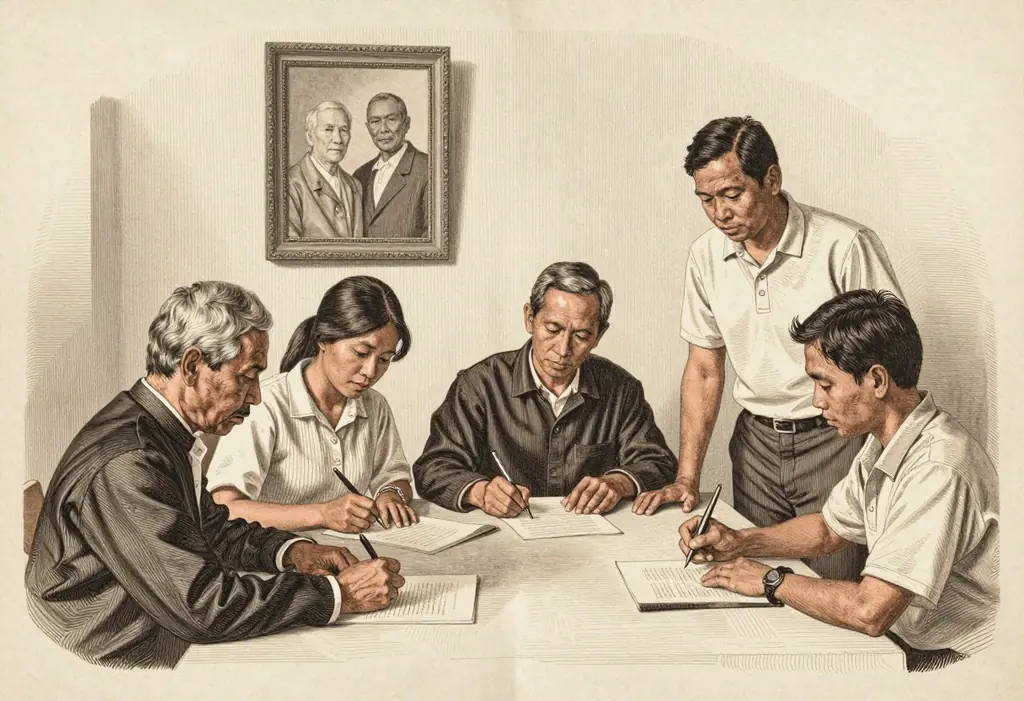 Full Plate
- Title is in seller's name with immediate capacity to convey
- Only requires Deed of Absolute Sale, CGT, and DST
- Clean title issued without Rule 74 two-year statutory lien
- No risk of unexpected omitted heirs claiming hereditary shares
- Every compulsory heir must sign the deed or notarized SPA
- Both Estate Tax (6%) and Transfer/Capital Gains Tax must be paid
- Requires 3 weeks newspaper publication before registration
- New title carries Rule 74 Section 4 two-year lien for excluded heirs
Never pay in full while the title remains in the deceased person's name without verified eCAR and all heir signatures.
Why
Under Article 777 of the Civil Code, rights to the succession are transmitted from the moment of death. However, surviving heirs do not individually own specific subdivided physical parcels until the estate is formally partitioned. Prior to partition, heirs are merely co-owners of an undivided hereditary estate under Article 1078. If only one heir sells the entire land without the written authority or signature of co-heirs, the sale is valid only up to the seller's ideal pro-indiviso share; the buyer becomes a co-owner with the remaining heirs and cannot take exclusive possession.
The standard mechanism for purchasing inherited property out of court is an Extrajudicial Settlement of Estate with Simultaneous Deed of Absolute Sale (EJS with Sale). Under Rule 74, Section 1 of the Rules of Court, this procedure is valid only if: (1) the deceased left no will, (2) the deceased left no unpaid debts, (3) all heirs are of legal age or minors are represented by guardians, and (4) the instrument is notarized and published in a newspaper of general circulation once a week for three consecutive weeks.
Beware of the statutory two-year lien under Rule 74, Section 4. When an extrajudicial settlement is registered, the Register of Deeds automatically annotates a two-year encumbrance on the transfer certificate of title. If an excluded legitimate or illegitimate child, or an unpaid creditor of the deceased emerges within two years from registration, they may compel judicial settlement and claim against the distributed property or its proceeds. A buyer in good faith takes the title subject to this annotated statutory lien.
Tax clearances cannot be bypassed. The Bureau of Internal Revenue requires the filing of the Estate Tax Return and payment of the 6% estate tax (NIRC Sec. 84 as amended by the TRAIN Law), alongside Capital Gains Tax (6%) and Documentary Stamp Tax (1.5%) for the subsequent sale. The Register of Deeds will strictly refuse to cancel the deceased owner's title or issue a new title to the buyer without the Electronic Certificate Authorizing Registration (eCAR) covering both the inheritance and the conveyance.
If any heir refuses to sell, cannot be located, or disputes ownership, an extrajudicial sale cannot proceed. The remedy of the willing heirs is to file a judicial action for partition under Rule 69. Any buyer paying earnest money to a single heir before all signatures and BIR clearances are secured faces prolonged litigation and risks losing both money and title.
People also read
Our parent died without a will and left land still titled in their name. How do we transfer it to the heirs?
If there is no will and no unpaid debts, and all heirs are of age or minors are properly represented, the heirs can settle the estate without going to court: sign a notarized extrajudicial settlement, publish it in a newspaper once a week for three consecutive weeks, pay the estate tax, and present the BIR clearance to the Register of Deeds for new titles (Rule 74, Rules of Court). If the heirs cannot agree, the remedy is a court action for partition or judicial settlement.
Not lawyer-reviewedRead the answer
The seller only has a tax declaration, or is selling 'rights', not a land title. Is it safe to buy the land?
It is risky. A tax declaration is a record for real property tax, not a certificate of title; at most it supports a claim of ownership, and a seller of 'rights' may be selling only possession of land that belongs to someone else or to the government. If you still buy, first verify the land's status and the seller's chain of ownership, use a notarized deed of sale, and record it with the Register of Deeds.
Not lawyer-reviewedRead the answer
My neighbor's fence or house extension is built over our boundary line. What can I do?
First prove where the line really is, through a relocation survey by a licensed geodetic engineer based on the technical description in your title, then bring the dispute to the barangay where the land is. If that fails, a court can order the encroached portion returned; what happens to a structure on your side depends on whether it was built in good or bad faith (Civil Code, Arts. 448–453).
Not lawyer-reviewedRead the answer
People built houses on my land without permission. How do I legally remove informal settlers?
Through the courts, not by force. Depending on how and when they entered, you file forcible entry or unlawful detainer within one year under Rule 70, or a longer case to recover possession or ownership after that; if the occupants are underprivileged and homeless, the eviction and demolition must also follow the notice, consultation, and relocation rules of Section 28 of the Urban Development and Housing Act (RA 7279). Squatting itself stopped being a crime when PD 772 was repealed, except for professional squatters and squatting syndicates.
Not lawyer-reviewedRead the answer