General information, not legal advice. This answer was written by the PhilippineLaws team from the law it cites and checked for accuracy to the best of our knowledge, last on Sep 21, 2026. It has not been reviewed by a lawyer. Read the cited law yourself, and for your own situation talk to a lawyer or the Public Attorney’s Office (PAO).
What happens if a check issued to me bounces? Can the issuer be jailed under BP 22?
Yes, it can happen. Issuing a check knowing you lack sufficient funds is a crime under Batas Pambansa Blg. 22 (Bouncing Checks Law), punishable by imprisonment of 30 days to one year, a fine of up to double the check's amount (capped at ₱200,000), or both. Supreme Court circulars tell judges to prefer a fine in suitable cases, but jail remains possible. To build a strong case, deposit the check within 90 days of its date and serve a written Notice of Dishonor that the issuer actually receives; the issuer then has five banking days to pay.
Illustrated Legal Brief
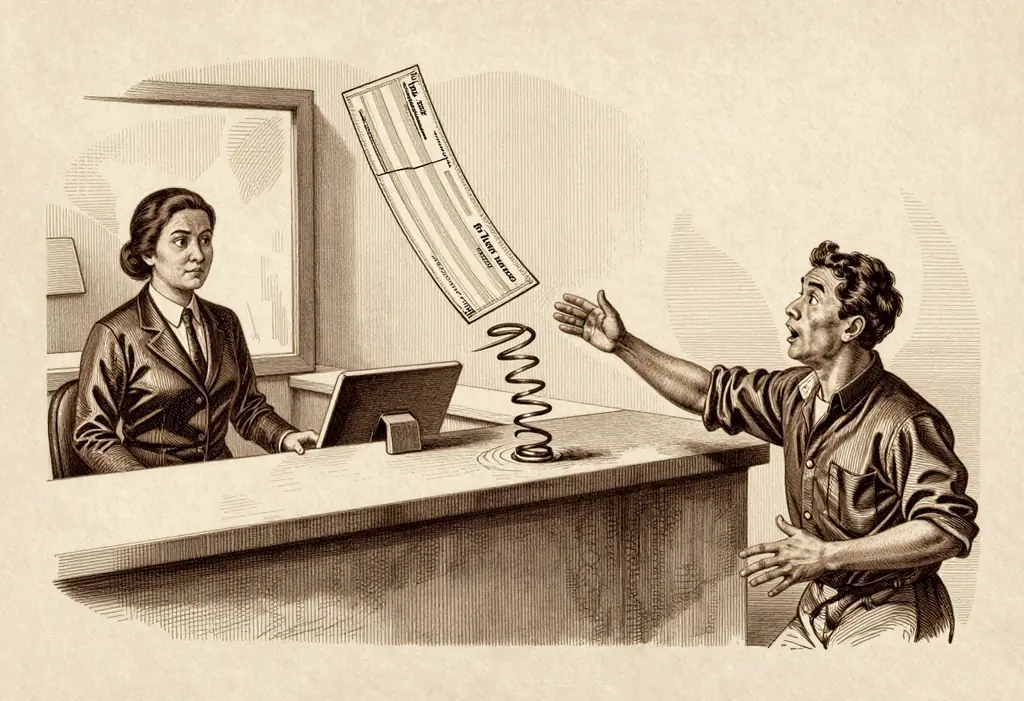 Full Plate
- Within 90 Days
Bank Presentment
Present check to drawee bank within 90 days of the date on the face of the check
- Dishonor
Not allowed: Bank Return Slip
Bank returns the check stamped with the reason for dishonor, e.g. DAIF (Drawn Against Insufficient Funds)
- Written Notice
Caution: Notice of Dishonor
Serve written notice of dishonor with verifiable proof of receipt (mail registry return or receiving copy)
- 5 Banking Days
Statutory Grace Period
Drawer has 5 banking days from receipt to pay the full check value or make arrangements
- After 5 Banking Days
Allowed: Prosecutor Filing
File a criminal complaint-affidavit for BP 22 (and Estafa, if the facts support it) at the Prosecutor's Office
Without proof that the drawer actually received a written Notice of Dishonor, a BP 22 case will usually fail.
Why
Batas Pambansa Blg. 22, the Bouncing Checks Law, penalizes the making, drawing, and issuance of a check without sufficient funds or credit. Unlike ordinary civil debts, where imprisonment is barred by the Bill of Rights, issuing a worthless check is punished as a malum prohibitum offense against public order and commercial confidence. The penalty under Section 1 is imprisonment of 30 days to one year, a fine of up to double the amount of the check (never more than ₱200,000), or both, at the court's discretion. Supreme Court Administrative Circular No. 12-2000, as clarified by Administrative Circular No. 13-2001, sets a rule of preference for a fine alone in appropriate cases, but it does not remove the judge's power to impose imprisonment.
A violation of BP 22 has three basic elements: (1) making, drawing, and issuing any check to apply on account or for value; (2) knowledge by the drawer at the time of issue that funds or credit with the drawee bank are insufficient; and (3) subsequent dishonor of the check by the drawee bank for insufficiency of funds or credit, or dishonor for the same reason had the drawer not, without valid reason, ordered the bank to stop payment.
Because knowledge is hard to prove directly, most cases rely on the law's prima facie presumption that the drawer knew funds were insufficient (Section 2). That presumption arises only if the check was presented to the bank within 90 days from the date appearing on it, it was dishonored, and the drawer received notice of the dishonor and still failed to pay the amount, or make arrangements for full payment, within five (5) banking days after receiving that notice. Paying within those five banking days prevents the presumption from arising.
A verbal notice, telephone conversation, or informal chat message is not enough: the Supreme Court has required a written Notice of Dishonor and has repeatedly overturned BP 22 convictions where the complainant failed to prove that the drawer actually received it. Proof of receipt—such as a personally signed receiving copy, or a registered mail registry return card together with proof of who signed for it—is critical.
BP 22 can be filed independently of, or alongside, a criminal charge of Estafa under Article 315 of the Revised Penal Code (Section 5 of BP 22 expressly allows this). While BP 22 punishes the issuance of a bad check without requiring proof of deceit, Estafa by means of a check requires deceit and damage: typically, the bad check was issued to obtain money, goods, or property at the time, rather than to pay a pre-existing debt. Criminal complaints for both offenses are filed with the City or Provincial Prosecutor.
People also read
Can an online lending app have me arrested for an unpaid loan?
No, not for the unpaid loan itself. The Constitution states that no person shall be imprisoned for debt, so simply failing to pay a loan is a civil matter and cannot put you in jail. The picture changes only if there was a separate crime, such as a bounced check or fraud in getting the loan. A lender or collection agent who threatens you with arrest, shames you to your phone contacts, or posts your photo online may itself be breaking SEC rules and the Data Privacy Act.
Not lawyer-reviewedRead the answer
I was scammed through GCash or online bank transfer. How can I recover my money and file criminal charges?
Report the fraud to GCash or your bank's fraud desk right away and ask them to hold the disputed funds in the recipient account, then file a cybercrime report with the PNP Anti-Cybercrime Group (PNP-ACG) or NBI Cybercrime Division. Recovery is not guaranteed and depends largely on whether the money is still in the recipient account. Under the Anti-Financial Account Scamming Act (AFASA / RA 12010) and the Cybercrime Prevention Act, scammers and money mules can face imprisonment and fines.
Not lawyer-reviewedRead the answer
Collection agencies and online loan apps are threatening police arrest, texting my employer, and posting on social media about my unpaid debt. Is this illegal harassment?
Yes, it is illegal. Under the 1987 Constitution, no person may be imprisoned for debt, and SEC Memorandum Circular No. 18 (2019) and BSP regulations strictly prohibit threats of violence or arrest, contacting third parties without consent, using profane slurs, and public shaming on social media.
Not lawyer-reviewedRead the answer
Someone borrowed money from me and won't pay it back. Can I file estafa and have them jailed?
Usually not. Failing to pay a loan is a civil matter, because the Constitution says no one may be imprisoned for debt; estafa applies only when there was deceit at the start, such as a fake identity or invented property used to get the money, or when money handed over in trust for a specific purpose was misappropriated. For an ordinary unpaid utang, the remedy is a written demand, barangay conciliation, and a collection case such as small claims.
Not lawyer-reviewedRead the answer