General information, not legal advice. This answer was written by the PhilippineLaws team from the law it cites and checked for accuracy to the best of our knowledge, last on Sep 21, 2026. It has not been reviewed by a lawyer. Read the cited law yourself, and for your own situation talk to a lawyer or the Public Attorney’s Office (PAO).
I was scammed through GCash or online bank transfer. How can I recover my money and file criminal charges?
Report the fraud to GCash or your bank's fraud desk right away and ask them to hold the disputed funds in the recipient account, then file a cybercrime report with the PNP Anti-Cybercrime Group (PNP-ACG) or NBI Cybercrime Division. Recovery is not guaranteed and depends largely on whether the money is still in the recipient account. Under the Anti-Financial Account Scamming Act (AFASA / RA 12010) and the Cybercrime Prevention Act, scammers and money mules can face imprisonment and fines.
Illustrated Legal Brief
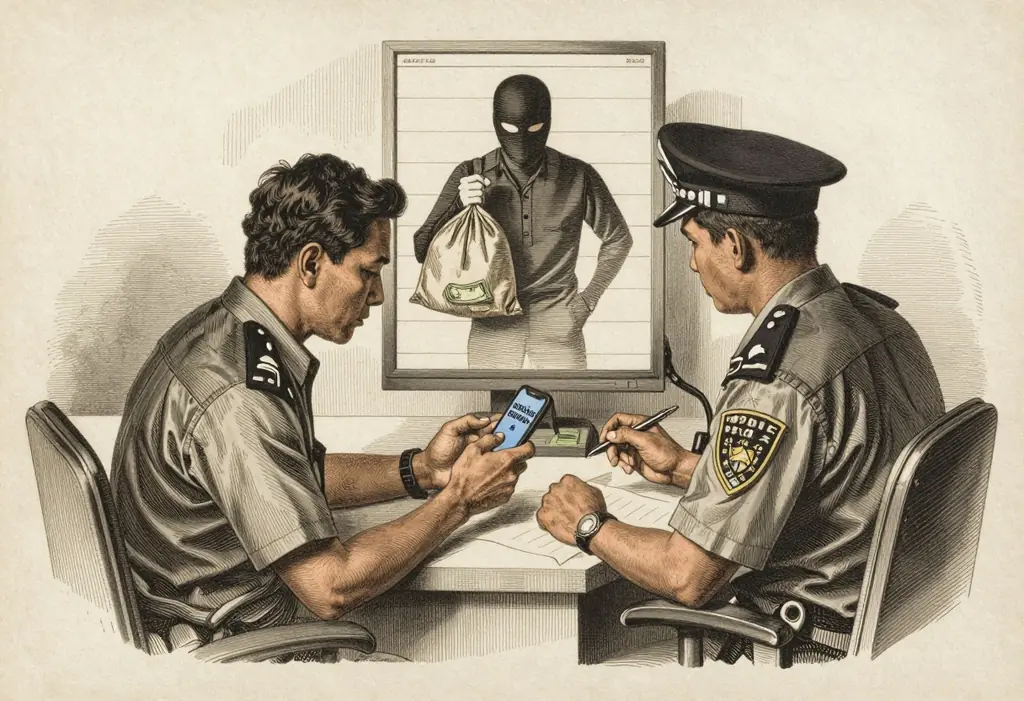 Full Plate
Capture All Digital Proof
Save screenshots of transaction slips, reference numbers, profile pages, and conversation logs
Caution: Call Fraud Hotline
Contact the e-wallet or bank fraud desk right away to flag the recipient account and ask for a hold on the disputed funds
File Police Cyber Report
Report to PNP Anti-Cybercrime Group (PNP-ACG) or NBI Cybercrime Division for official investigation
Allowed: Obtain Incident Blotter
Secure the police or NBI report documenting the fraud; investigators can later subpoena the telco's SIM registration records
Allowed: Prosecutor Complaint
Submit a sworn complaint-affidavit for Estafa in relation to RA 10175 (and AFASA violations, if applicable) before the Prosecutor
Under AFASA (RA 12010), money mules who knowingly let their accounts be used to move scam proceeds face 6 to 8 years' imprisonment, a fine of ₱100,000 to ₱500,000, or both.
Why
Financial fraud committed online—such as fake e-commerce stores, task and investment scams, phishing links, and deceptive loan platforms—is rampant in the Philippines. Victims have structured legal remedies under both specialized cybercrime laws and the Revised Penal Code.
Under Republic Act No. 12010, the Anti-Financial Account Scamming Act (AFASA) enacted in 2024, banks and electronic money issuers (EMIs) like GCash and Maya must maintain adequate fraud controls and take part in a coordinated verification of disputed transactions. AFASA criminalizes 'money muling'—knowingly using, lending, selling, buying, or renting a bank or e-wallet account, or opening one under a false identity, to receive or move proceeds of crimes or scams—punishable by 6 to 8 years' imprisonment, a fine of ₱100,000 to ₱500,000, or both. It also lets financial institutions temporarily hold funds involved in a disputed transaction for up to 30 days, unless a court extends it. If an institution failed to maintain adequate safeguards, it can be made to restore the account owner's funds, even without a criminal conviction.
Perpetrating fraud over digital networks constitutes Estafa under Article 315 of the Revised Penal Code in relation to Section 6 of Republic Act No. 10175 (the Cybercrime Prevention Act of 2012). Under RA 10175, all offenses committed by, through, and with the use of information and communications technologies (ICT) are penalized with a penalty one degree higher than that provided in the Revised Penal Code.
Time is the single most critical factor in recovering stolen funds. An e-wallet or bank will not simply reverse a completed transfer because you ask, but reporting the transfer immediately gives its fraud team the chance to hold the disputed funds in the recipient account before the scammer withdraws them or moves them to other mule accounts. Once the money has left the system, recovery usually depends on a court case.
To press criminal charges and seek restitution in court, the victim files a sworn Complaint-Affidavit before the Office of the City or Provincial Prosecutor. Even if the scammer used a fake profile name, a competent authority can subpoena the telco's SIM registration records under the SIM Registration Act (RA 11934) when a sworn complaint shows the number was used to commit a crime, and financial account records can be examined through the BSP's investigation powers under AFASA and through court-issued cybercrime warrants.
People also read
Someone keeps threatening me by text and chat, saying they'll hurt me or my family. Is that a crime, and what can I do?
Yes, it can be. Threatening to inflict on you or your family, or on your property, a wrong that would itself be a crime, such as killing, hurting, or burning, is grave threats under Article 282 of the Revised Penal Code; threats of lesser wrongs are light threats or other light threats. When the threat is sent through text, chat, or social media, the Cybercrime Prevention Act raises the penalty by one degree, so save the messages and report them.
Not lawyer-reviewedRead the answer
Can I be sued for cyberlibel over a Facebook post or comment?
Yes. Defamatory Facebook posts or comments can constitute cyberlibel under Republic Act No. 10175, which carries a heavier penalty than ordinary libel. However, truth published with good motives and for justifiable ends is a defense, and the Supreme Court has held that cyberlibel cannot be applied to people who merely receive a post and react to it, such as by liking or sharing it, without adding defamatory remarks of their own.
Not lawyer-reviewedRead the answer
I already had the incident blottered at the barangay or police. Does that mean a case has been filed?
No. A blotter is only a logbook record that you reported an incident; it does not start a case, summon the other person, or stop the deadline for filing. To actually pursue someone, you file a complaint with the Lupong Tagapamayapa for minor disputes between people living in the same city or municipality, or a sworn complaint-affidavit with the prosecutor's office.
Not lawyer-reviewedRead the answer
My relative was arrested without a warrant. How long can the police hold him before a case is filed, and what is an inquest?
Under Article 125 of the Revised Penal Code, a person arrested without a warrant must be delivered to the proper judicial authorities within 12, 18, or 36 hours, depending on whether the offense carries a light, correctional, or afflictive penalty. In practice this means an inquest prosecutor must file the case in court within that time or the person should be released, and throughout the detention he has the right to remain silent and to a lawyer.
Not lawyer-reviewedRead the answer