General information, not legal advice. This answer was written by the PhilippineLaws team from the law it cites and checked for accuracy to the best of our knowledge, last on Sep 21, 2026. It has not been reviewed by a lawyer. Read the cited law yourself, and for your own situation talk to a lawyer or the Public Attorney’s Office (PAO).
The store has a 'No return, no exchange' sign and refuses to replace an item that turned out to be defective. Is that allowed?
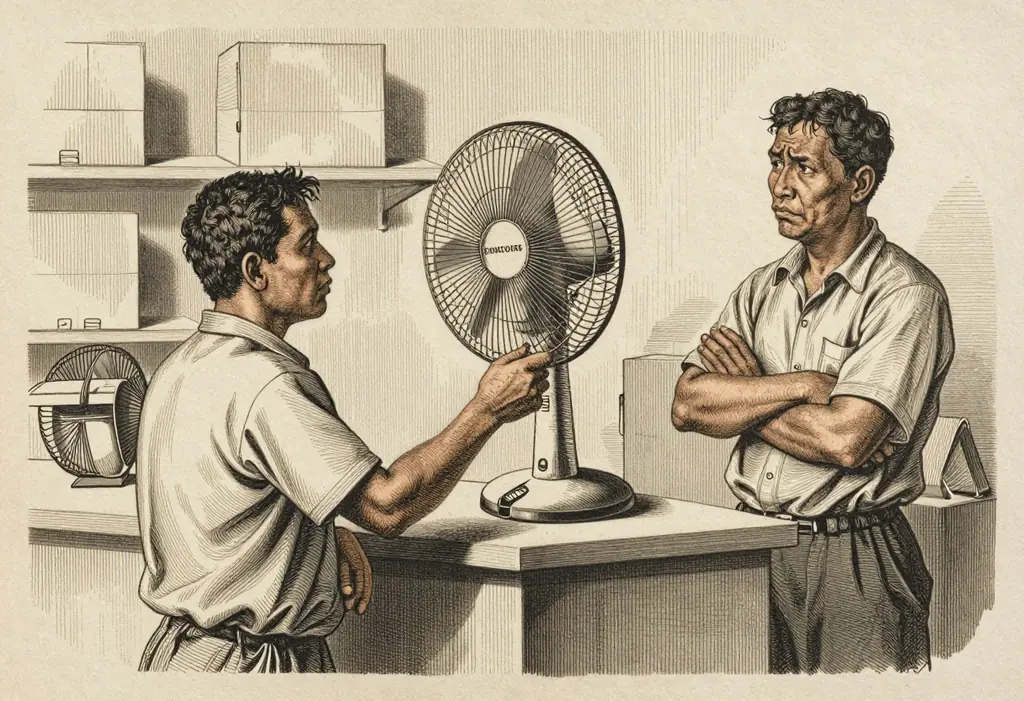
Not for defective goods. Under the Consumer Act (Republic Act No. 7394), sellers are liable for defects that make a product unfit or reduce its value, and a store sign cannot waive that. You can demand repair of the defect, and if it is not fixed within 30 days, a replacement, a refund, or a price reduction. A store may, however, refuse a return if you simply changed your mind about a product that has nothing wrong with it.
Illustrated Legal Brief
 Full Plate
- Item is defective, broken or does not work as intended
- Item does not match its label, packaging or advertisement
- Defect not repaired within 30 days: you choose replacement, refund or a price cut
- A 'No return, no exchange' sign does not change this
- You changed your mind about the size, colour or style
- You found it cheaper elsewhere
- The damage was caused by misuse or unreasonable use
- Any exchange here is the store's goodwill, not your legal right
Claims under the Consumer Act prescribe in two years from the purchase, or from discovery of a hidden defect.
Why
Article 100 of the Consumer Act of the Philippines (Republic Act No. 7394) makes suppliers of consumer products jointly liable for imperfections in quality that make the products unfit or inadequate for their intended use or decrease their value, and for inconsistencies with what the label, packaging or advertisement said. The consumer can first demand replacement of the imperfect parts. If the imperfection is not corrected within 30 days, the consumer may choose between: (a) replacement with another product of the same kind in perfect condition; (b) immediate reimbursement of the amount paid, without prejudice to damages; or (c) a proportionate price reduction. If the defect is so serious that replacing parts would compromise the product's quality or value, the consumer may go straight to those three options.
A 'No return, no exchange' sign cannot take these rights away. Article 105 says the legal guarantee that a product is adequate does not require any express document, and forbids contractually exonerating the supplier. Article 106 prohibits any clause that prevents, exonerates or reduces the obligation to indemnify for damages under these provisions. Article 167 adds that the Act applies notwithstanding any agreement to the contrary. Under Article 104, the seller's ignorance of the defect is no excuse.
Where the product came with a written warranty, Article 68 adds more. You enforce the warranty simply by presenting the warranty card or the official receipt together with the product to the immediate seller, and no other documentary requirement may be demanded. A retailer that is not itself the distributor must present the warranty claim to the distributor on your behalf, at no cost to you. Under Article 72, refusing without valid legal cause, or unreasonably delaying, to honour a warranty is a prohibited act. The Civil Code's warranty against hidden defects (Article 1561) also still applies, giving the buyer the choice under Article 1567 between withdrawing from the sale and a proportionate price reduction, with damages. That Civil Code action must be brought within six months from delivery (Article 1571).
The rule protects you against defects, not against regret. If the item works exactly as described and you simply changed your mind about the size, colour or style, the law does not force the store to take it back. Many stores do allow exchanges as a matter of goodwill, so it is worth asking, but that is their policy, not your legal right. The Act also does not protect you against damage you caused yourself: under Article 68, a warrantor is not required to perform if it shows the defect was caused by unreasonable use.
If the store refuses, the Department of Trade and Industry handles complaints under Articles 159 to 164. Its consumer arbitration officers first try to settle the case and, failing settlement, may hear and decide it, with administrative penalties including restitution, an assurance to replace, repair or refund, and fines of ₱500 to ₱300,000. Under Article 169, claims under the Act must be brought within two years from the transaction or, for hidden defects, from discovery.
People also read

Can a restaurant or store refuse senior citizen or PWD discounts during promotional sales?
No, a store cannot completely deny the statutory benefit. Under Republic Act Nos. 9994 and 10754, while double discounting is prohibited, the senior citizen or PWD has the explicit legal right to choose between the store's promotional price and the statutory 20% discount plus 12% VAT exemption, whichever gives them the lower price.
Not lawyer-reviewedRead the answer
Can stores give candy instead of change or refuse to give exact change?
No. Under Republic Act No. 10909 (the No Shortchange Act of 2016), it is illegal for any business establishment to shortchange a consumer, fail to provide exact change down to the last centavo, or substitute candy or other goods for cash. Violating businesses face progressive administrative fines up to ₱25,000 and total revocation of their mayor's permit.
Not lawyer-reviewedRead the answer
I ordered something online and received the wrong item, a fake, or a broken one, and the seller won't refund me. What are my rights?
Under the Internet Transactions Act of 2023 (Republic Act No. 11967), an online merchant must deliver goods in the same condition, type, quantity and quality as described, and if they are defective or do not conform you can demand repair, replacement or a refund under the Consumer Act. Use the platform's or seller's internal complaint process first; if it is unresolved after seven calendar days, you may go to the DTI. The seller is primarily liable, and the platform can be held subsidiarily liable in specific cases.
Not lawyer-reviewedRead the answer
My brand-new car keeps coming back to the casa for the same defect. Can I demand a replacement or refund under the Lemon Law?
Possibly. Under the Philippine Lemon Law (Republic Act No. 10642), if a brand-new car has a defect that substantially impairs its use, value or safety, and the same dealer has failed to fix it after at least four separate repair attempts within 12 months or 20,000 km of delivery (whichever comes first), you can give written notice, allow one final repair, and then go to the DTI. If the DTI finds a nonconformity, it orders the dealer or manufacturer to replace the vehicle or take it back and refund the purchase price plus collateral charges, less an allowance for use.
Not lawyer-reviewedRead the answer