General information, not legal advice. This answer was written by the PhilippineLaws team from the law it cites and checked for accuracy to the best of our knowledge, last on Sep 29, 2026. It has not been reviewed by a lawyer. Read the cited law yourself, and for your own situation talk to a lawyer or the Public Attorney’s Office (PAO).
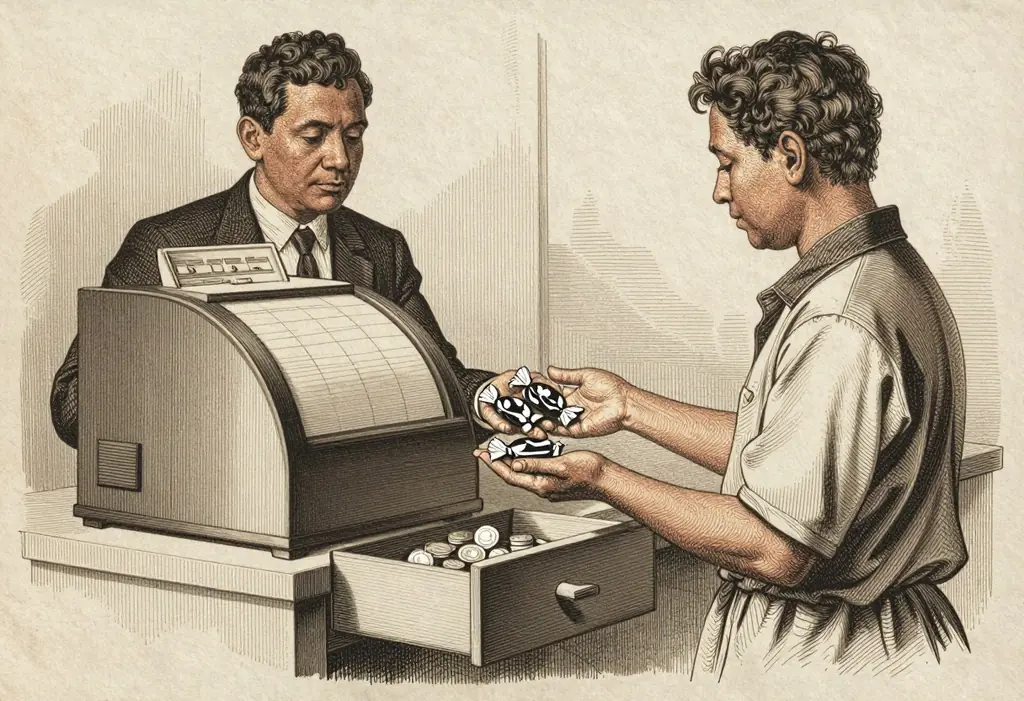
Can stores give candy instead of change or refuse to give exact change?
No. Under Republic Act No. 10909 (the No Shortchange Act of 2016), it is illegal for any business establishment to shortchange a consumer, fail to provide exact change down to the last centavo, or substitute candy or other goods for cash. Violating businesses face progressive administrative fines up to ₱25,000 and total revocation of their mayor's permit.
Illustrated Legal Brief
 Full Plate
- 1st Offense
₱500 fine
Or 3% of gross daily sales (whichever is higher)
- 2nd Offense
Caution: ₱5,000 fine
Or 5% of gross daily sales
- 3rd Offense
Not allowed: ₱15,000 fine + 3-month suspension
Temporary suspension of mayor's permit and business license
- 4th Offense
Not allowed: ₱25,000 fine + permit revocation
Total cancellation of business permit to operate
Under RA 10909 Sec. 4(b), substituting candy, gum, or matchboxes for monetary change is strictly prohibited even if the customer agrees.
Why
Republic Act No. 10909, known as the 'No Shortchange Act of 2016', was enacted to protect consumers from the pervasive practice of business establishments failing to give exact change or giving candy, mints, and other small items in place of monetary change.
Section 4 of the law lays down strict prohibitions: (1) It is unlawful to shortchange or give change less than the amount due to the consumer, regardless of how small the amount; (2) It is unlawful to give other forms of goods (such as candy) in lieu of cash change, even if the consumer consents; and (3) It is unlawful to price an item in centavos unless the establishment maintains sufficient coins to issue change down to the exact centavo.
The excuse that the store 'has no coins' or 'walang barya' is explicitly rejected by the law. Section 4(c) mandates that every business establishment must ensure they have sufficient denominations of Philippine legal tender, including centavo coins, before opening their cash registers each day.
Furthermore, Section 5 requires that every invoice, official receipt, or point-of-sale tape issued to the consumer must clearly indicate the exact amount of cash tendered and the exact change returned.
The penalties under Section 6 are progressive: ₱500 or 3% of the gross sales of the day (whichever is higher) for the 1st offense; ₱5,000 or 5% of daily gross sales for the 2nd offense; ₱15,000 or 7% of daily gross sales plus a 3-month business permit suspension for the 3rd offense; and ₱25,000 or 10% of daily gross sales and permanent revocation of the mayor's permit to operate for the 4th offense.
People also read
I ordered something online and received the wrong item, a fake, or a broken one, and the seller won't refund me. What are my rights?
Under the Internet Transactions Act of 2023 (Republic Act No. 11967), an online merchant must deliver goods in the same condition, type, quantity and quality as described, and if they are defective or do not conform you can demand repair, replacement or a refund under the Consumer Act. Use the platform's or seller's internal complaint process first; if it is unresolved after seven calendar days, you may go to the DTI. The seller is primarily liable, and the platform can be held subsidiarily liable in specific cases.
Not lawyer-reviewedRead the answer
The cashier charged me more than the price on the shelf tag, or added a charge nobody told me about. Do I have to pay the higher amount?
No. Article 81 of the Consumer Act (Republic Act No. 7394) makes it unlawful to offer consumer products for retail sale without a displayed price, and says they shall not be sold at a price higher than the one stated. You can insist on paying the tagged price. Charges that were not disclosed before you bought, or prices that were misrepresented, can also be deceptive sales practices you can report to the DTI.
Not lawyer-reviewedRead the answer
The store has a 'No return, no exchange' sign and refuses to replace an item that turned out to be defective. Is that allowed?
Not for defective goods. Under the Consumer Act (Republic Act No. 7394), sellers are liable for defects that make a product unfit or reduce its value, and a store sign cannot waive that. You can demand repair of the defect, and if it is not fixed within 30 days, a replacement, a refund, or a price reduction. A store may, however, refuse a return if you simply changed your mind about a product that has nothing wrong with it.
Not lawyer-reviewedRead the answer
Can a restaurant or store refuse senior citizen or PWD discounts during promotional sales?
No, a store cannot completely deny the statutory benefit. Under Republic Act Nos. 9994 and 10754, while double discounting is prohibited, the senior citizen or PWD has the explicit legal right to choose between the store's promotional price and the statutory 20% discount plus 12% VAT exemption, whichever gives them the lower price.
Not lawyer-reviewedRead the answer