General information, not legal advice. This answer was written by the PhilippineLaws team from the law it cites and checked for accuracy to the best of our knowledge, last on Sep 29, 2026. It has not been reviewed by a lawyer. Read the cited law yourself, and for your own situation talk to a lawyer or the Public Attorney’s Office (PAO).
Am I entitled to paid leave after undergoing surgery for PCOS, ovarian cyst, or myoma?
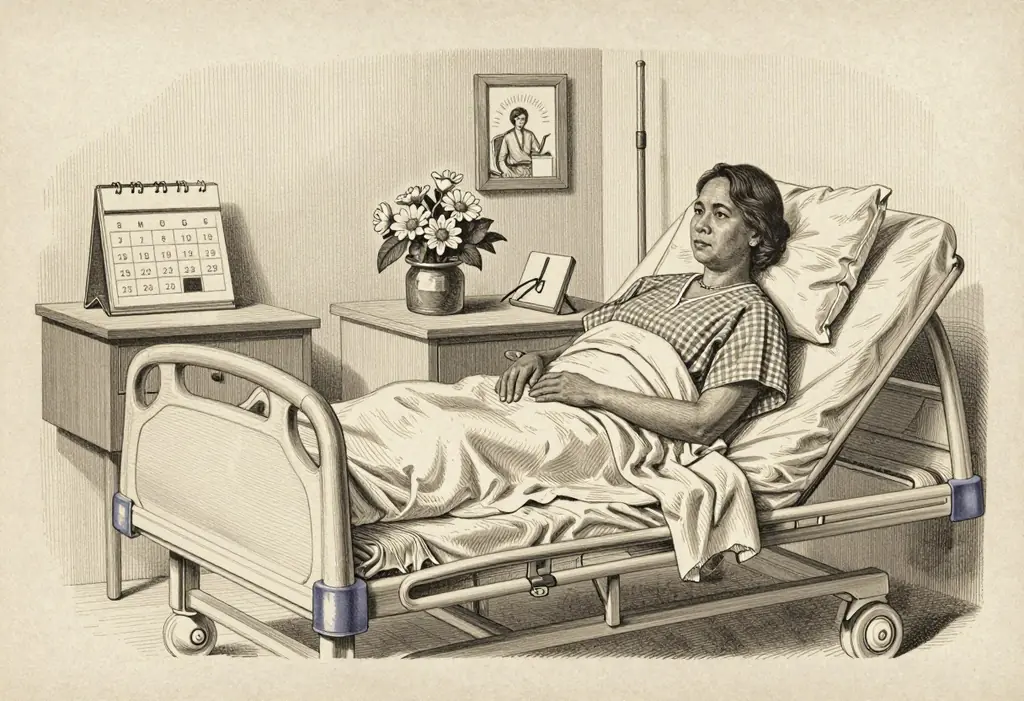
Yes. Under Section 18 of Republic Act No. 9710 (the Magna Carta of Women), a female employee in either the private or public sector is entitled to a special paid leave benefit of up to two (2) months following surgery caused by gynecological disorders, provided she has rendered at least six months of continuous aggregate service in the last twelve months.
Illustrated Legal Brief
 Full Plate
Verify 6-month service qualification
Rendered at least 6 months continuous aggregate service in the last 12 months
Allowed: Obtain OB-GYN surgical certification
Secure medical certificate and operative record stating surgical procedure and recuperation period
Allowed: File application under RA 9710
Submit formal leave application for Special Leave Benefit with HR
Allowed: Full pay for up to 2 months
Employer pays basic wage and regular allowances without deducting existing leave credits
Under RA 9710 Sec. 18, this 2-month paid leave is in addition to existing sick, vacation, and maternity leaves.
Why
Under Section 18 of Republic Act No. 9710 (the Magna Carta of Women) and DOLE Department Order No. 112-11, female employees who undergo surgery due to gynecological disorders are entitled to a Special Leave Benefit (SLB) of up to two (2) months with full pay.
Gynecological disorders covered by the law include disorders involving the female reproductive organs that require surgical procedures. Common covered procedures include myomectomy (removal of uterine fibroids), hysterectomy (removal of the uterus), oophorectomy (removal of ovaries for cysts or tumors), dilation and curettage (D&C) for abnormal bleeding or pregnancy complications, and laparoscopic surgery for severe polycystic ovary syndrome (PCOS) or endometriosis.
To qualify for this special paid leave, the employee must have rendered continuous aggregate employment service of at least six (6) months for the last twelve (12) months in the company. Unlike ordinary sick leave, the Special Leave Benefit under the Magna Carta of Women is paid directly by the employer, based on the employee's basic monthly salary plus mandatory allowances.
This special leave is non-cumulative and non-convertible to cash if unused. However, it is granted in addition to standard vacation leave, sick leave, maternity leave, and solo parent leave. An employer cannot deduct these two months from the employee's existing leave credits.
An employer who refuses to grant this statutory benefit or retaliates against a female worker who avails of it commits an unfair labor practice and is liable for administrative sanctions and damages before DOLE and the NLRC.
People also read
My contract keeps getting renewed every five months. Am I already a regular employee?
Quite possibly. Regular status under Article 295 depends on what you actually do — if the work is necessary or desirable to the employer's usual business, you are regular no matter what the contract is titled or how many times it was cut short, unless the arrangement is genuine project, seasonal or fixed-term employment. And a contractor that supplies you without substantial capital or real control makes the principal your employer by law.
Not lawyer-reviewedRead the answer
I went AWOL. Can my employer just consider me resigned and keep my last pay?
No on both counts. Absence alone is not abandonment, because the employer must also prove a clear intention on your part to sever the relationship, and it must still run the two-notice process before dismissing you. Your earned wages and pro-rated benefits are yours regardless, though days you did not work are unpaid.
Not lawyer-reviewedRead the answer
My employer is making my job impossible so I will quit. Is that constructive dismissal?
Yes — if a reasonable person in your position would feel compelled to give up the job, the law treats it as a dismissal even though you were the one who walked. The usual signs are a demotion, a cut in pay or benefits, an unexplained transfer, or treatment so hostile that staying is unbearable. You have to show the facts first, but once you show a demotion, pay cut or transfer, the burden shifts to the employer to prove the change was legitimate.
Not lawyer-reviewedRead the answer
What is the correct overtime rate, and can my company make me waive it?
Work beyond eight hours on an ordinary day is paid at your hourly rate plus 25%; on a rest day, special day or holiday it is the hourly rate applicable to that day plus 30%. An agreement to waive overtime pay is void, and undertime on one day can never be offset against overtime on another.
Not lawyer-reviewedRead the answer