General information, not legal advice. This answer was written by the PhilippineLaws team from the law it cites and checked for accuracy to the best of our knowledge, last on Sep 29, 2026. It has not been reviewed by a lawyer. Read the cited law yourself, and for your own situation talk to a lawyer or the Public Attorney’s Office (PAO).
When am I entitled to retirement pay in the Philippines, and how is it computed?
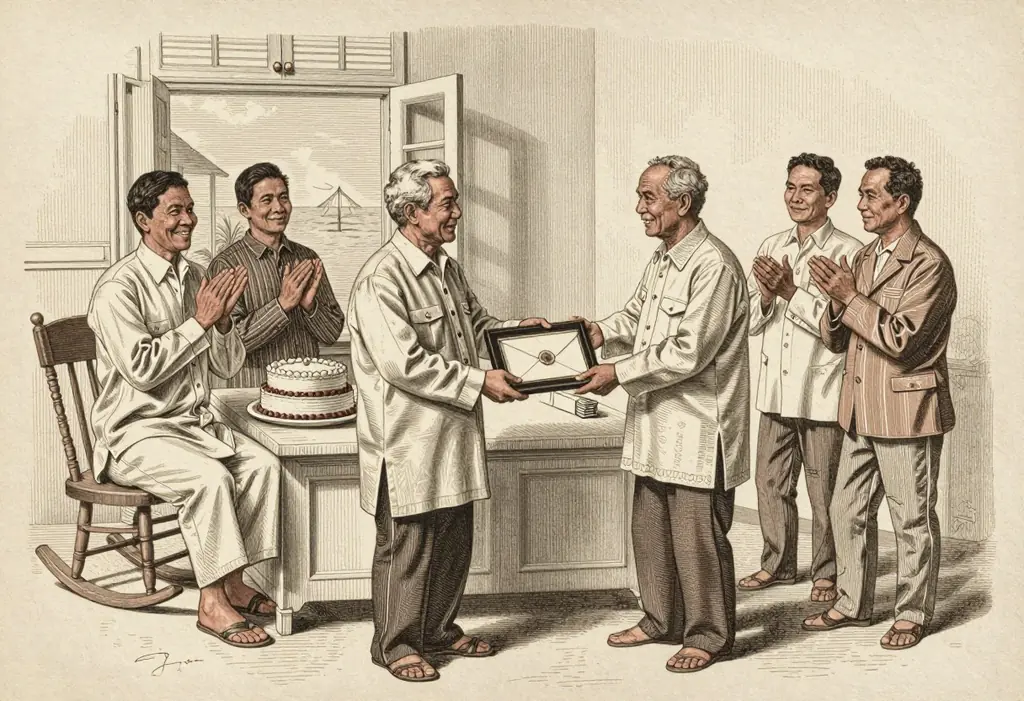
Under Article 302 of the Labor Code (as amended by Republic Act No. 7641), an employee who has served at least 5 years can optionally retire at age 60, with mandatory retirement at age 65. The statutory minimum retirement pay equals at least one-half month's salary for every year of service, which the law defines as 22.5 days' pay (15 days basic wage + 5 days service incentive leave + 2.5 days for the 13th-month pay share).
Illustrated Legal Brief
 Full Plate
Years of Service × 22.5 Days × Daily Basic Wage
A fraction of at least 6 months is credited as 1 full year. The 22.5 days factor is mandatory unless company policy or CBA provides a higher amount.
Why
Under Article 302 (formerly Art. 287) of the Labor Code, as amended by Republic Act No. 7641 (The Retirement Pay Law), private sector employees in the Philippines are entitled to statutory retirement pay. In the absence of a collective bargaining agreement (CBA) or applicable company retirement plan, an employee who reaches age 60 (optional retirement) or age 65 (compulsory retirement) and has completed at least five (5) years of service with the employer is entitled to statutory retirement pay upon separation.
The law establishes a minimum floor for retirement pay: at least 'one-half (1/2) month salary for every year of service'. However, the term 'one-half month salary' does not mean 15 days of wages. Under the Supreme Court's ruling in Elegir v. Philippine Airlines and DOLE implementing guidelines, one-half month salary consists of: (1) 15 days basic salary based on the employee's latest wage rate, (2) 5 days representing the cash equivalent of unused Service Incentive Leave (SIL), and (3) 2.5 days representing one-twelfth (1/12) of the 13th-month pay (15 + 5 + 2.5 = 22.5 days).
Service years are computed strictly: any remaining fraction of at least six (6) months is treated as one whole year of service. For example, an employee with 10 years and 7 months of service is credited with 11 full years.
An employer is free to offer a company retirement scheme or negotiate a retirement package in a CBA, provided the total benefits do not fall below the statutory 22.5-day benchmark. If the company plan pays less, the employer must make up the difference.
Under Section 32(B)(6)(a) of the National Internal Revenue Code (NIRC), retirement benefits received under a reasonable private benefit plan approved by the BIR are completely exempt from income tax, provided the employee has been in the service of the same employer for at least 10 years and is at least 50 years of age at the time of retirement.
People also read

I went AWOL. Can my employer just consider me resigned and keep my last pay?
No on both counts. Absence alone is not abandonment, because the employer must also prove a clear intention on your part to sever the relationship, and it must still run the two-notice process before dismissing you. Your earned wages and pro-rated benefits are yours regardless, though days you did not work are unpaid.
Not lawyer-reviewedRead the answer
Can I resign immediately, or do I really have to render 30 days?
The default is 30 days' written notice, but the Labor Code lets you walk out the same day in four situations — serious insult, inhuman treatment, a crime committed against you or your family, and causes analogous to those. Outside those, your employer can waive the notice or hold you liable for damages it can actually prove, but it cannot refuse to let you go.
Not lawyer-reviewedRead the answer
My contract keeps getting renewed every five months. Am I already a regular employee?
Quite possibly. Regular status under Article 295 depends on what you actually do — if the work is necessary or desirable to the employer's usual business, you are regular no matter what the contract is titled or how many times it was cut short, unless the arrangement is genuine project, seasonal or fixed-term employment. And a contractor that supplies you without substantial capital or real control makes the principal your employer by law.
Not lawyer-reviewedRead the answer
What is the difference between holiday pay and premium pay, and what am I owed on a holiday?
Holiday pay is the 100% of your daily wage you receive on a regular holiday even without working; premium pay is the extra percentage added when you do work on a day you were not supposed to. On a regular holiday you get 200% for the first eight hours, while a special non-working day is no-work-no-pay and 130% if you work it.
Not lawyer-reviewedRead the answer