General information, not legal advice. This answer was written by the PhilippineLaws team from the law it cites and checked for accuracy to the best of our knowledge, last on Sep 25, 2026. It has not been reviewed by a lawyer. Read the cited law yourself, and for your own situation talk to a lawyer or the Public Attorney’s Office (PAO).
Can private messages or venting in a private group chat (GC) be charged as cyberlibel?
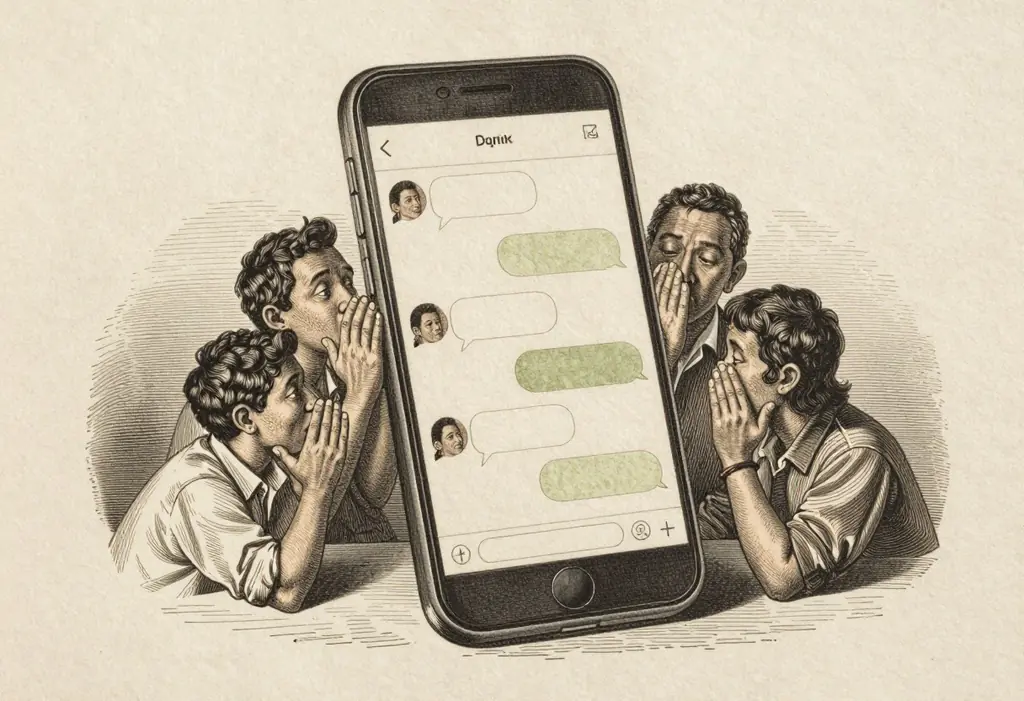
Yes, it can — if the message is seen by a third person. Under Philippine law, 'publication' does not require a public post; communicating defamatory remarks to even one person other than the victim satisfies the publication element. However, the prosecution must still prove malice, defamatory character, and the exact identity of the sender.
Illustrated Legal Brief
 Full Plate
- Element 1
Defamatory Imputation
Accuses someone of a crime, vice, defect, or act causing dishonor.
- Element 2
Publication
Communicated to at least one third party (satisfied by group chat members).
- Element 3
Identifiability
The third party recognizes who is being talked about.
- Element 4
Malice
Presumed by law unless privileged communication or justifiable motive is shown.
Why
Under Article 353 of the Revised Penal Code, libel is a public and malicious imputation of a crime, vice, or defect tending to cause the dishonor, discredit, or contempt of a natural or juridical person. Section 4(c)(4) of the Cybercrime Prevention Act of 2012 (RA 10175) penalizes libel committed through a computer system with penalties one degree higher than under the RPC.
A widespread myth is that a private Facebook Messenger group chat, Viber circle, or Telegram group is immune from libel charges. In Philippine jurisprudence, 'publication' is defined as the communication of the defamatory matter to some third person or persons. When an insult or accusation is sent into a group chat with coworkers, friends, or family, the third-party requirement is immediately satisfied.
However, not every unflattering remark constitutes cyberlibel. The statement must be defamatory, must identify the victim (explicitly or by obvious reference), and must be malicious. Expressions of opinion, fair commentary on matters of legitimate interest, and confidential communications between persons who have a legal, moral, or social duty to communicate (qualified privileged communication) are defenses.
Furthermore, screenshots taken by members of a private group chat must be authenticated under the Rules on Electronic Evidence (A.M. No. 01-7-01-SC) to be admissible in court.
People also read

Can I be sued for cyberlibel over a Facebook post or comment?
Yes. Defamatory Facebook posts or comments can constitute cyberlibel under Republic Act No. 10175, which carries a heavier penalty than ordinary libel. However, truth published with good motives and for justifiable ends is a defense, and the Supreme Court has held that cyberlibel cannot be applied to people who merely receive a post and react to it, such as by liking or sharing it, without adding defamatory remarks of their own.
Not lawyer-reviewedRead the answer
I went AWOL. Can my employer just consider me resigned and keep my last pay?
No on both counts. Absence alone is not abandonment, because the employer must also prove a clear intention on your part to sever the relationship, and it must still run the two-notice process before dismissing you. Your earned wages and pro-rated benefits are yours regardless, though days you did not work are unpaid.
Not lawyer-reviewedRead the answer
My contract keeps getting renewed every five months. Am I already a regular employee?
Quite possibly. Regular status under Article 295 depends on what you actually do — if the work is necessary or desirable to the employer's usual business, you are regular no matter what the contract is titled or how many times it was cut short, unless the arrangement is genuine project, seasonal or fixed-term employment. And a contractor that supplies you without substantial capital or real control makes the principal your employer by law.
Not lawyer-reviewedRead the answer
Someone posted my private chat, phone number, and address online. Can I sue for doxxing?
Yes. Publishing your private mobile number, residential address, or intimate chat messages online without your consent is illegal under the Data Privacy Act of 2012 (Republic Act No. 10173) and carries higher penalties under the Cybercrime Prevention Act. You can file a formal complaint with the National Privacy Commission (NPC) and file criminal charges for unauthorized disclosure.
Not lawyer-reviewedRead the answer