General information, not legal advice. This answer was written by the PhilippineLaws team from the law it cites and checked for accuracy to the best of our knowledge, last on Sep 21, 2026. It has not been reviewed by a lawyer. Read the cited law yourself, and for your own situation talk to a lawyer or the Public Attorney’s Office (PAO).
Can my employer withhold my Certificate of Employment (COE) or delay my clearance beyond 30 days?
Not the COE, and not indefinitely for final pay. Under DOLE Labor Advisory No. 06, Series of 2020, an employer must issue your Certificate of Employment (COE) within three (3) days from your request, and must release your final pay within thirty (30) days from your separation date unless a company policy or agreement is more favourable to you. The advisory does not make the COE conditional on clearance. Clearance itself is allowed, and an employer may hold final pay while company property is returned, but not as a penalty.
Illustrated Legal Brief
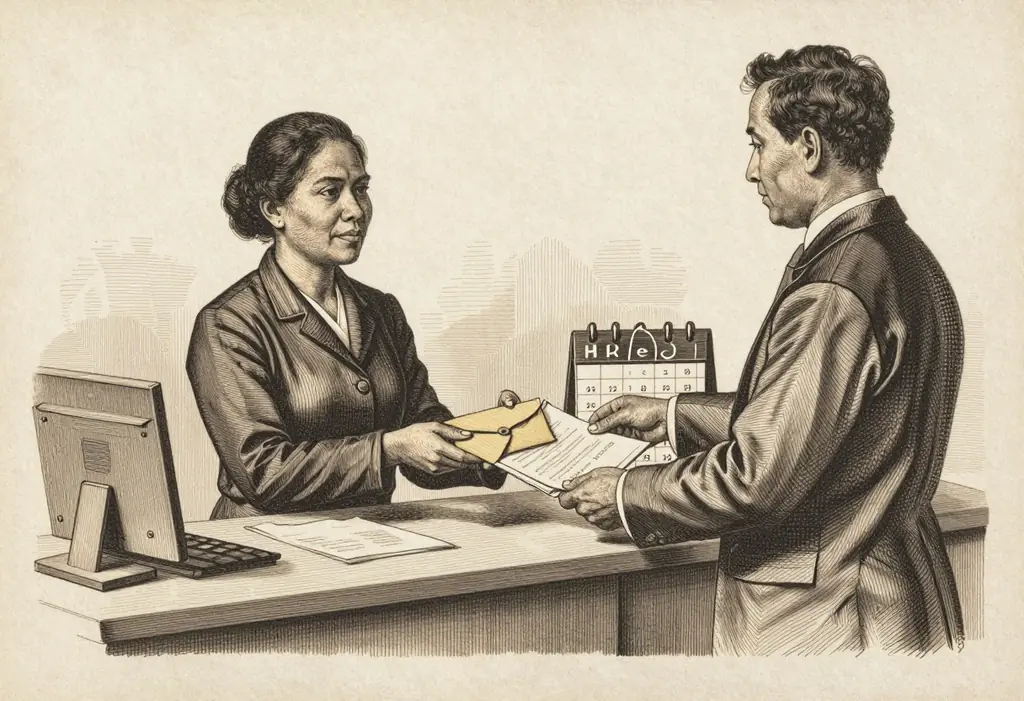 Full Plate
- Day 0
Separation Date
Last day of employment / turnover and clearance initiation
- 3 Days
Allowed: COE Release Deadline
Counted from your request. The advisory attaches no clearance condition
- 30 Days
Allowed: Final Pay Deadline
Release of final wages, pro-rated 13th month and unused SIL, unless company policy is more favourable
- If missed
Caution: DOLE SEnA Mediation
File a Request for Assistance through e-SEnA for a 30-day conciliation-mediation
The COE should not be held hostage over company property disputes. Final pay may be held while company property is returned, but not as a penalty.
Why
A Certificate of Employment (COE) is an official document stating the date of engagement, the date of separation, and the specific role or position held by an employee. Under DOLE Labor Advisory No. 06, Series of 2020, an employer must issue the COE within three (3) days from the time of the employee's request.
A common corporate practice is withholding an employee's COE until the employee completes a lengthy clearance process, returns company equipment, or signs a liability waiver. The advisory's three-day rule carries no such condition: the COE is a factual record of your employment, not a payment, so a clearance dispute is not a reason to delay it. Even if an employee resigned without proper notice or has pending liabilities, the employer should still issue the certificate within 3 days of the request.
Regarding final pay, Labor Advisory No. 06-20 sets the period: final pay must be released within thirty (30) days from the date of separation or termination of employment, unless a company policy, individual agreement or collective bargaining agreement is more favourable to the employee. Clearance procedures are not unlawful in themselves. The Supreme Court has upheld an employer's withholding of terminal pay pending the employee's return of company property (Milan v. NLRC, G.R. No. 202961, February 4, 2015). What an employer cannot do is use clearance as an open-ended excuse, or keep final pay as a penalty.
Final pay covers all compensation earned by the employee up to their separation: unpaid regular wages, pro-rated 13th-month pay, cash conversion of unused Service Incentive Leave (SIL), separation pay (if applicable), and excess tax withholding refunds. Deductions are strictly limited under Articles 113 and 116 of the Labor Code to those authorized by law or explicitly authorized in writing by the employee.
If an employer refuses to issue a COE within 3 working days or withholds final pay beyond 30 calendar days, the employee can file a Request for Assistance (RFA) under the Single Entry Approach (SEnA) with the nearest DOLE Field Office or through the online e-SEnA portal. DOLE provides a mandatory 30-day conciliation-mediation procedure to enforce compliance.
People also read
I went AWOL. Can my employer just consider me resigned and keep my last pay?
No on both counts. Absence alone is not abandonment, because the employer must also prove a clear intention on your part to sever the relationship, and it must still run the two-notice process before dismissing you. Your earned wages and pro-rated benefits are yours regardless, though days you did not work are unpaid.
Not lawyer-reviewedRead the answer
My contract keeps getting renewed every five months. Am I already a regular employee?
Quite possibly. Regular status under Article 295 depends on what you actually do — if the work is necessary or desirable to the employer's usual business, you are regular no matter what the contract is titled or how many times it was cut short, unless the arrangement is genuine project, seasonal or fixed-term employment. And a contractor that supplies you without substantial capital or real control makes the principal your employer by law.
Not lawyer-reviewedRead the answer
Can I resign immediately, or do I really have to render 30 days?
The default is 30 days' written notice, but the Labor Code lets you walk out the same day in four situations — serious insult, inhuman treatment, a crime committed against you or your family, and causes analogous to those. Outside those, your employer can waive the notice or hold you liable for damages it can actually prove, but it cannot refuse to let you go.
Not lawyer-reviewedRead the answer
My employer is making my job impossible so I will quit. Is that constructive dismissal?
Yes — if a reasonable person in your position would feel compelled to give up the job, the law treats it as a dismissal even though you were the one who walked. The usual signs are a demotion, a cut in pay or benefits, an unexplained transfer, or treatment so hostile that staying is unbearable. You have to show the facts first, but once you show a demotion, pay cut or transfer, the burden shifts to the employer to prove the change was legitimate.
Not lawyer-reviewedRead the answer